

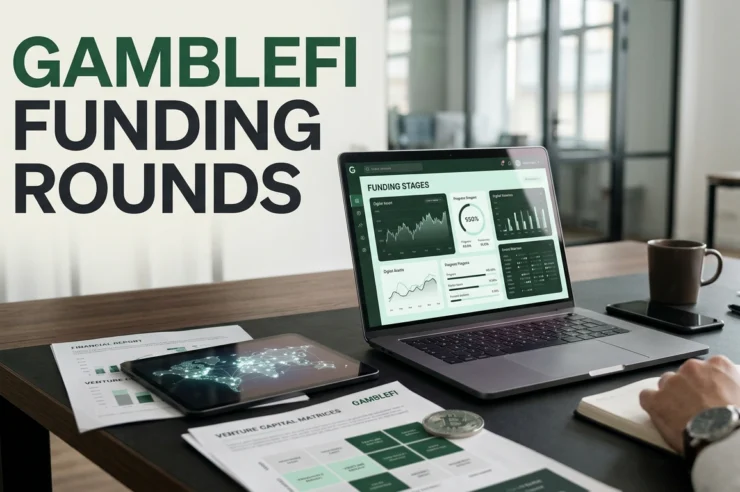
GambleFi has attracted venture firms that previously focused on crypto infrastructure, DeFi, and Web3 gaming. Funding has flowed into crypto casinos, social gaming platforms, sportsbooks, and on-chain betting products. Several projects have secured multimillion-dollar rounds from established blockchain investors.
Direct answer: GambleFi funding rounds have included deals ranging from $2.5 million seed investments to $30 million Series A financings. Monkey Tilt, MyPrize, Yeet, Shuffle, and DoubleUp have attracted investors including Pantera Capital, Polychain Capital, Dragonfly, Mysten Labs, and other crypto-focused firms.
| Project | Announced funding | Stage or structure | Notable investors |
|---|---|---|---|
| Monkey Tilt | $21M | Funding round, February 2024 | Polychain, Hack VC, PokerGO, Accomplice, Folius Ventures |
| Shuffle | $2.5M | Seed, February 2024 | Karatage, Cypher Capital, Axiom and others |
| MyPrize | $5M + $8M | Two equity rounds with token warrants | Dragonfly, Boxcars Ventures and others |
| Monkey Tilt | $30M | Series A, November 2024 | Pantera, Polychain, Hack VC, Mirana and others |
| Yeet | $7.75M | Funding round, March 2025 | Dragonfly and angel investors |
| DoubleUp | $4M | Seed, May 2025 | Karatage, Mysten Labs, Selini Capital and others |
Key Takeaways
- Monkey Tilt disclosed more than $50 million across two major 2024 financings.
- MyPrize disclosed $13 million through two rounds structured as equity with token warrants.
- Yeet raised $7.75 million in 2025, with Dragonfly leading the financing.
- DoubleUp disclosed a $4 million seed round involving several established Web3 investors.
- Venture financing and public token sales are different funding methods and should not be combined blindly.
- U.S. readers should separate a company’s fundraising activity from its legal availability in their state.
What GambleFi Funding Rounds Tell Us About the Sector
The term GambleFi generally describes gambling or betting products that use cryptocurrency, blockchains, tokens, or decentralized financial infrastructure. CoinGecko describes it as bringing crypto-based gambling applications on-chain. The category can include casinos, betting applications, and related financial mechanisms.
Funding databases do not always label these companies as GambleFi. A single project might appear under gaming, betting, DeFi, gambling, or Web3. That classification problem makes sector totals difficult to compare accurately. Investors often focus on the underlying business rather than one category label.
The clearest evidence comes from individual financing announcements. Round size, investors, financing structure, and dates signal more clearly than marketing terminology. This approach also prevents token presales from being mistaken for institutional venture financings.
Monkey Tilt Raised $21 Million Before a $30 Million Series A
Monkey Tilt represents one of the largest clearly documented funding stories in crypto-enabled gambling. The company disclosed a $21 million financing in February 2024. Investors included Polychain Capital, Hack VC, PokerGO, Accomplice, Paper Ventures, and Folius Ventures.
The company followed that deal with a $30 million Series A announced in November 2024. Pantera Capital led the new round. Polychain, PokerGO, Hack VC, Dream Ventures, Accomplice, Mirana, and Josh Hannah also participated.
That second financing pushed reported capital raised above $50 million. The funding pattern also shows investors returning across consecutive rounds. Polychain, Hack VC, PokerGO, and Accomplice participated in both stages.
For U.S. readers, Monkey Tilt is especially relevant because the company has Las Vegas roots. Its financing also brought traditional gaming experience together with crypto-focused venture capital. That combination shows how the sector can extend beyond anonymous token launches.
MyPrize Raised $13 Million Across Two Early Rounds
MyPrize emerged from stealth in March 2024 with $13 million in disclosed financing. The first round raised $5 million during October 2023. A second financing added another $8 million in March 2024.
The company said both financings used equity with token warrants. Dragonfly led the first deal, while Boxcars Ventures led the second. Other participants included Mechanism Capital, Arrington Capital, Breed VC, and several individual investors.
MyPrize also demonstrates why U.S. context matters. Its founders described separate offerings for American and international audiences at launch. The U.S. operation used a free-to-play social casino model, while its global site offered real-money crypto gaming.
That distinction is important when evaluating fundraising headlines. A well-funded crypto gaming business might operate different products across jurisdictions. Financing does not establish that every service is available everywhere in America.
Shuffle Secured $2.5 Million in Seed Capital
Shuffle completed a $2.5 million seed financing in February 2024. DefiLlama categorizes the company under betting and describes it as a crypto casino and sports betting platform. The investor group included Karatage, Cypher Capital, Sunforge, ODA Capital, Axiom, and others.
The round is smaller than Monkey Tilt’s later financings. Still, it illustrates the broad range of checks entering crypto gambling businesses. Early-stage projects can attract specialized funds before reaching larger institutional rounds.
Readers comparing these projects should consider funding stages alongside dollar amounts. A $2.5 million seed deal serves a different purpose from a $30 million Series A. Stage, product maturity, regulatory work, hiring, and customer growth can affect capital requirements.
Yeet Raised $7.75 Million in 2025
Yeet announced $7.75 million in financing during March 2025. Dragonfly led the deal, according to Decrypt. Angel investors included figures associated with Pudgy Penguins and LayerZero.
The company positioned itself as a crypto-native casino and sportsbook. Its founders came from backgrounds in crypto trading and professional poker. That positioning suggests investors backed both the product and the founders’ existing audiences.
Founder reputation can matter in emerging crypto categories. Yet readers should still examine product controls, security, licensing, and business economics separately. Coinswey’s cryptography security coverage provides useful background on evaluating current crypto security developments.
DoubleUp Added a $4 Million Seed Round
DoubleUp disclosed a $4 million seed round in May 2025. Karatage led the financing. Mysten Labs, Selini Capital, Comma3 Ventures, Four Pillars, Alpha DAO, Auros Global, and EBlock Capital also participated.
The project operates on Sui and combines decentralized finance concepts with gaming. Its investor list therefore includes firms closely connected with blockchain infrastructure and liquidity markets. Mysten Labs’ participation is particularly relevant because of its connection with the Sui ecosystem.
This deal reflects another direction for the sector. Some funded companies resemble conventional online gaming businesses that accept crypto. Others place blockchain mechanics much closer to the product’s financial core.
Venture Rounds, Token Sales, and ICOs Are Not the Same
Crypto funding statistics can become misleading when every capital event receives the same label. Venture equity gives investors ownership in a company. Token warrants can add rights connected with a future digital asset.
ICOs and public presales work differently. TG. Casino, for example, has a documented initial coin offering rather than a conventional venture round. Crunchbase lists one ICO funding event for the project.
Projects can also use several structures during their lifecycle. Investors should identify who provided capital and what they received. Coinswey’s DePIN token launch playbook explains why token design, treasury controls, legal review, and product readiness need separate analysis.
| Funding type | Typical participant | What capital may receive | Main issue to check |
|---|---|---|---|
| Seed or Series A | Venture funds | Company equity | Valuation, dilution, growth plans |
| Equity plus warrants | Venture funds | Equity and future token rights | Token terms and legal structure |
| Private token round | Funds or accredited participants | Token allocation | Vesting and supply terms |
| ICO or presale | Broader token buyers | Tokens | Distribution, disclosure, regulatory risk |
Why Crypto Investors Are Funding Gambling Products

One attraction is the already large online gaming market. Crypto infrastructure can add stablecoin payments, blockchain settlement, digital assets, and globally accessible technical rails. Investors may also see potential in products that blend gaming with social communities.
The investor overlap is revealing. Pantera, Polychain, Dragonfly, Karatage, Mysten Labs, and other crypto firms appear across the documented transactions. Several already invest broadly across DeFi, infrastructure, gaming, and token-based applications.
Funding interest also extends into adjacent prediction markets. The Block reported more than $216 million across 11 prediction-market deals during 2025. Prediction markets are not identical to GambleFi, but the capital flow shows investor interest in event-based financial products.
Investors still face major execution risks. User acquisition can be expensive, regulations vary by jurisdiction, and crypto products add custody concerns. Funding size alone says little about whether a platform will build a sustainable business.
What U.S. Readers Should Check Before Interpreting a Funding Announcement
American readers should first determine what entity completed the financing. A global crypto brand may have separate operating companies, websites, or product rules. The funded corporate entity might not provide every advertised product in America.
Next, distinguish company investment from access to an investment opportunity. A venture fund backing a private business does not make its shares publicly available. A token sale also follows different rules from ordinary venture financing.
Finally, check product availability separately from the funding story. Gambling rules, financial regulations, and product eligibility can differ across U.S. jurisdictions. A large venture round does not establish nationwide legal availability.
Coinswey’s crypto calendar risk-management guide can help readers track scheduled market events. Its Maneki wallet guide also covers practical wallet considerations for crypto users.
What the Funding Pattern Suggests
The documented deals show that institutional capital is willing to back several GambleFi business models. The largest examples combine crypto mechanics with familiar casino, sportsbook, or social gaming concepts. Smaller seed rounds often focus more heavily on blockchain-native infrastructure.
Repeat investors matter as much as headline funding totals. Monkey Tilt brought several investors back for its Series A after its earlier financing. That continued participation can indicate investor conviction, although it never guarantees commercial success.
The sector also shows a growing split between venture financing and retail token fundraising. That distinction should make future comparisons more useful. Readers can judge corporate capital, token economics, and platform performance as separate questions.
Frequently Asked Questions
What are GambleFi funding rounds?
GambleFi funding rounds are capital raises involving crypto-enabled gambling, betting, casino, or related blockchain gaming businesses. They can include seed rounds, Series A financing, private token deals, or mixed structures. Each structure gives investors different rights and risks.
What is the largest funding round covered here?
Monkey Tilt’s $30 million Series A is the largest single round among the core crypto gambling companies reviewed here. Pantera Capital led the November 2024 financing. The company said total capital raised had surpassed $50 million afterward.
Which investors are active in this category?
Documented participants include Pantera Capital, Polychain Capital, Dragonfly, Hack VC, Karatage, Mysten Labs, and several specialist funds. Their involvement spans different projects and financing stages. Participation does not mean each investor follows one unified GambleFi strategy.
Does venture funding mean a GambleFi platform is legal across the United States?
No, a funding announcement does not determine a platform’s legal status across America. Product availability can depend on the service and relevant jurisdiction. U.S. readers should verify current eligibility and terms before using any gambling-related product.
Are token presales the same as venture funding?
No, token presales and venture rounds use different structures. Venture investors typically receive equity, while token buyers receive digital assets or rights to future tokens. Some financings combine equity with token warrants, so the transaction documents matter.
The Bottom Line
GambleFi has moved beyond projects financed only through community token sales. Venture-backed businesses have now attracted checks ranging from several million dollars to tens of millions. The investor base includes some of crypto’s better-known venture firms.
The strongest way to follow the sector is to compare disclosed transactions rather than promotional claims. Track round size, stage, investor names, financing structure, and product jurisdiction. Those details explain far more than a project’s funding headline alone.
For Coinswey readers, the next step is to treat funding as one part of project research. Pair financing history with security, token structure, product access, and operating evidence. That approach gives U.S. readers a clearer view of where the money is going.